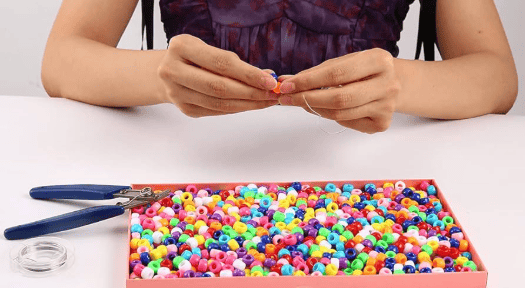
Last night at 8 PM, a craft blogger was live-streaming the disassembly of an old bracelet when the elastic band suddenly snapped, scattering beads across the table. She grabbed a few large-hole ABS imitation pearls—8mm in diameter and 2.5mm in hole—so easy to thread through her fingertip that even a beginner could easily wrap them around three times with one hand without getting stuck. Smiling, she strung two beads into the end of a hair tie, added a small bell, and instantly created a jingling summer hair accessory. The live stream chat was flooded with comments: “These holes are so user-friendly!” “Link please!” “My mom says she can string them herself!”
These large-hole beads are designed specifically for soft threads like elastic bands, waxed thread, and elastic cords, unlike regular beads which require enlarging the holes or changing to finer needles. The smooth, matte surface is gentle on the skin, has a warm feel similar to real pearls, but is lighter, more durable, and sweat-resistant. Beading can be used to make bracelets, hair ties, keychains, wind chimes, or even sewn onto the edges of canvas bags as three-dimensional decorations—it works obediently whenever you want to “wrap” it around. Betty Jewelry’s ABS faux pearls have smooth, burr-free holes; when poured into the palm of your hand, they rustle and swirl, like holding a handful of sun-warmed seashells. A touch of soft white on the wrist in summer—not flashy, but sure to catch the eye.
Beading, an ancient and creative craft, has spanned thousands of years. From ancient dynasties to modern family craft workshops, beading has always played an important role in decoration and symbolism. The forms, colors, and materials of beads are endless, resulting in countless beading techniques. If you are a beginner or simply want to improve your crafting skills, this article will introduce 26 interesting beading techniques to help you quickly master this art. 1. Basic Straight Line Beading: One of the simplest and most common beading methods, straight line beading involves stringing beads one after another in a certain order to form a smooth line. This weaving technique is not only suitable for necklaces and bracelets, but is also often used as the base for various small ornaments. If you want more complex patterns, you can try flat weaving. You create a flat pattern by threading beads through multiple lines. Ornaments woven in this way often present beautiful geometric shapes and rich color variations. Interlaced weaving is a technique that creates patterns by weaving beads alternately. It allows the beads to present different directions, bringing a three-dimensional and dynamic effect. This weaving technique is suitable for making earrings, necklaces, etc.
Double-line weaving involves threading two lines of beads in parallel, which increases the stability and thickness of the weave, suitable for pieces that require support, such as bracelets and bangles. Loop weaving refers to beads repeatedly interlacing along the same trajectory to form a loop effect. This method is very suitable for making ornaments that require a circular structure, such as earrings and rings. Double-row weaving arranges beads in two rows simultaneously, making the woven ornament richer. This method is particularly suitable for making wide bracelets and necklaces, giving the finished product a heavier visual effect. Zipper weaving is like interlacing two beaded lines together like a zipper. The resulting structure has a distinct striped texture, suitable for creating highly textured decorations. The circular weaving method involves arranging beads within a circular frame to form a closed loop. This method is often used to make pendants and earrings, creating a rounded and full visual effect.
If you’d like to buy solid-color, large-hole small horse beads for DIY jewelry making, you can check out AliExpress; they have a particularly popular style. You could try buying it.
About the Author